Replacing goddess culture
Updated On: 27 October, 2024 08:31 AM IST | Mumbai | Devdutt Pattanaik
But today Navaratri and Diwali festival is all about Ram and Krishna



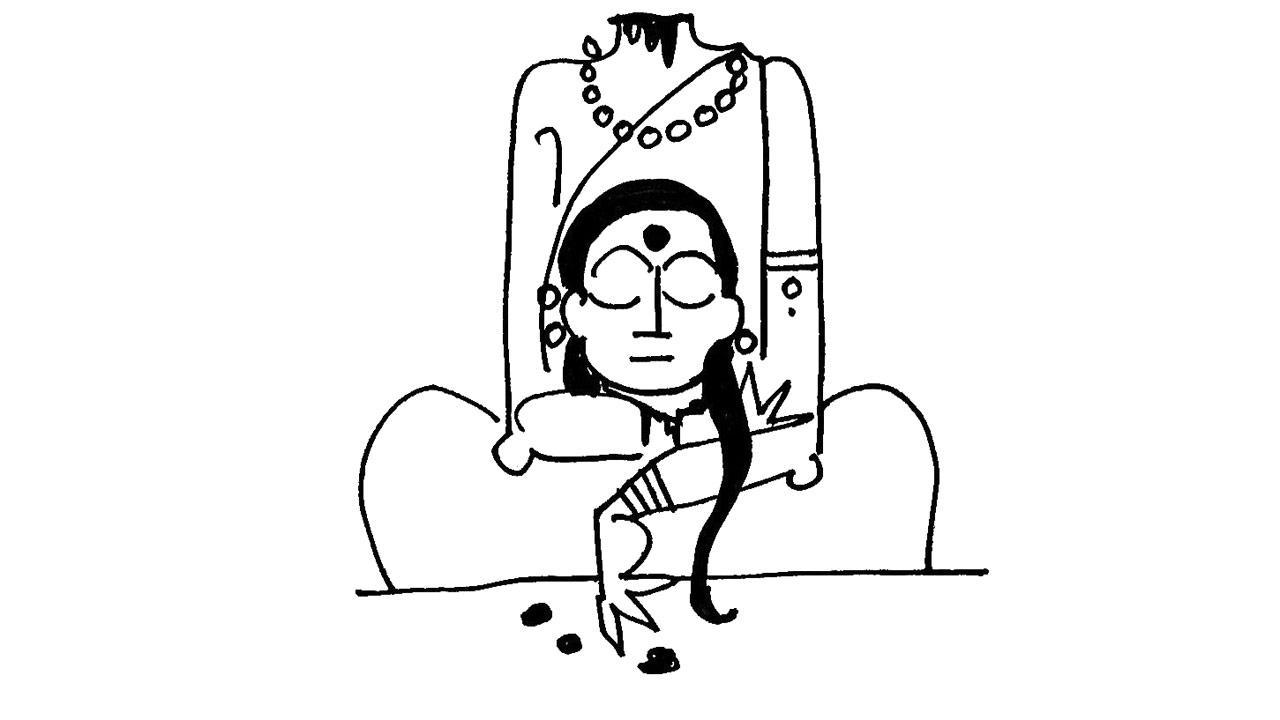
Illustration/Devdutt Pattanaik
 In Hindu mythology, the four months of the rainy season is when Vishnu sleeps. Who protects the world then? It is the Goddess, identified as Yogamaya. And so traditionally, women’s festivals, involving Goddesses, are found in the latter half of the rainy season after the autumn equinox.
In the Deccan region, autumn is the time when Vara-Lakshmi and Mangala-Gauri are worshipped in the form of a pot by women. In the Hindi speaking belt, it begins with the three Teej festivals (Hariyali, Kajari, Hartalika). In Maharashtra’s coastal region, people celebrate Gauri’s arrival at her parent’s house. Shortly thereafter comes Navaratri, the festival of Durga battling the buffalo-demon, said to be the days when the Goddess visits her parents. Durga and Gauri are forms of Shakti, Shiva’s wife. In South India, the Navaratri is the time when Lakshmi, Saraswati and Kali are worshipped, each for three days. When she comes to her father’s house she is fed food she likes—fish especially. Women take a lead in these festivals. The goddess is often represented by herbs. After Navaratri comes Sharad Purnima, linked to Radha in Gujarat and Lakshmi in Bengal. Then comes Diwali, linked to Lakshmi in Gujarat and Kali in Bengal. Between Dassera and Diwali, there is the women’s festival of Karwa Chauth. After Diwali, in Bihar, women celebrate Chhat puja. Then comes the marriage of Tulsi to Vishnu, when he awakens. In the Kartik Purnima that follows, Shiva shoots the arrow to bring down Tripura, three cities of the asuras.
Trending Stories
Latest Photos
Latest Videos
Latest Web Stories
ADVERTISEMENT
Mid-Day Fast
ADVERTISEMENT

ADVERTISEMENT